How Does the Alternative Dispute Resolution Method Peer Review Work?
 | |
| Abbreviation | ASCE |
|---|---|
| Founded | November v, 1852 (1852-xi-05) |
| Type | Engineering society |
| Focus | Purpose of the grouping is the advancement of the science and profession of Civil engineering and the enhancement of human being welfare through the activities of society members.[1] |
| Location |
|
| Expanse served | Worldwide |
| Method | Industry standards, conferences, publications |
| Members | 143,189 (2021 ASCE Official Register) |
| Official language | English |
| President | Dennis D. Truax, Ph.D., P.E. (2022) |
| Past President | Jean-Louis Briaud, Ph.D., P.Due east., (2021) |
| President elect | Maria C. Lehman, P.Eastward. |
| Secretary and Executive Managing director | Thomas W. Smith Three |
| Revenue | US $56.viii million (2019)[ii] |
| Endowment | US $32.2 meg (2019)[ii] |
| Employees | 250 |
| Website | asce |
The American Social club of Civil Engineers (ASCE) is a taxation-exempt professional body founded in 1852 to represent members of the ceremonious engineering science profession worldwide. Headquartered in Reston, Virginia, it is the oldest national engineering society in the United States.[3] Its constitution was based on the older Boston Order of Civil Engineers from 1848.[4]
ASCE is defended to the advancement of the scientific discipline and profession of civil applied science and the enhancement of human welfare through the activities of society members.[1] It has more than 143,000 members in 177 countries. Its mission is to provide essential value to members, their careers, partners, and the public; facilitate the advancement of technology; encourage and provide the tools for lifelong learning; promote professionalism and the profession; develop and support civil engineers.[i]
History [edit]
The first serious and documented attempts to organize civil engineers as a professional society in the newly created U.s.a. were in the early 19th century.[5] [6] In 1828, John Kilbourn of Ohio, managed a brusque-lived "Ceremonious Engineering Journal", editorializing about the recent incorporation of the Institution of Ceremonious Engineers in Great U.k. that same yr, Kilbourn suggested that the American corps of engineers could constitute an American society of civil engineers.[six] [five] Later on, in 1834, an American trade periodical, the "American Railroad Journal" advocated for similar national organization of civil engineers.[6]
Establishment of American Civil Engineers [edit]
On December 17, 1838, a petition started circulating request civil engineers to meet in 1839 in Baltimore, Maryland to organize a permanent society of civil engineers.[half dozen] Prior to that, 13 notable civil engineers largely identifiable as being from New York, Pennsylvania, or Maryland met in Philadelphia. This grouping presented the Franklin Found of Philadelphia with a formal proposal that an Institution of American Civil Engineers be established as an adjunct of the Franklin..."[6] Some of them were:[6]
- Benjamin Wright. In 1969, the American Order of Civil Engineers alleged Wright to exist the 'Begetter of American Ceremonious Engineering'.[7]
- William Strickland
- Pennsylvanians Edward Miller and Solomon. West. Roberts, the latter being Chief Engineer for the Allegheny Portage railroad, the beginning crossing of the Allegheny mountains (1831–1834)
Twoscore engineers really appeared at the Feb 1839 meeting Baltimore including J. Edgar Thomson (Future Chief Engineer and later President of the Pennsylvania Railroad), Wright, Roberts, Edward Miller, and the Maryland engineers Isaac Trimble and architect Benjamin H. Latrobe and attendees from as far as Massachusetts, Illinois, and Louisiana.[6] Afterwards, a group met once more in Philadelphia, led by its Secretary, Edward Miller to take steps to formalize the society, participants now included such other notable engineers every bit:[6]
- John B. Jervis
- Claudius Crozet
- William Gibbs McNeill
- George Washington Whistler
- Walter Gwynn
- J. Edgar Thompson
- Sylvester Welch, brother of future ASCE president Ashbel Welch
- Other members included Jonathan Knight and Moncure Robinson.
Miller drafted upward a proposed constitution which gave the society'due south purpose equally "the collection and diffusion of professional knowledge, the advancement of mechanical philosophy, and the summit of the character and continuing of the Ceremonious Engineers of the United States."[half dozen] Membership in the new society restricted membership to engineers and "architects and eminent machinists were to be admitted simply every bit Associates."[8] The proposed constitution failed, and no farther attempts were made to form another society.[half dozen] Miller after ascribed the failure due to the difficulties of assembling members due bachelor means for traveling in the country at time.[6] I of the other difficulties members would have to contend with was the requirement to produce each year, i previously unpublished paper or "...nowadays a scientific book, map, programme or model, non already in the possession of the Society, under the penalty of $x."[viii] In that same period, the editor of the American Railroad Journal commented that effort had failed in part due to sure jealousies which arose due to the proposed affiliation with the Franklin Establish.[half dozen] That journal continued discussion on forming an engineers' arrangement from 1839 thru 1843 serving its ain self interests in advocating its journal as a replacement for a professional society just to no avail.
The American Society of Civil Engineers and Architects [edit]
During the 1840s, professional organizations continued to develop and organize in the Usa. The organizers motives were largely to "meliorate common standards, foster inquiry, and disseminate knowledge through meetings and publications."[9] Unlike earlier associations such as the American Philosophical Society, these newer associations were non seeking to limit membership as much as pursue "more specialized interests."[ix] Examples of this surge in new professional organizations in America were the American Statistical Association (1839), American Ethnological Society (1842), American Medical Clan (1847), American Clan for the Advancement of Scientific discipline, (1848) and National Education Association (1852).[ix]
During this same menses of association incorporations on the 1840s, attempts were again made at organizing an American engineer clan. They succeeded at first with the Boston Society of Civil Engineers, organized in 1848 and and so in Oct 1852, with an endeavour to organize a Social club of Ceremonious Engineers and Architects in New York.[6] [eight] Led past Alfred Due west. Craven, Master Engineer of the Croton Aqueduct and future ASCE president, the meeting resolved to incorporate the society under the proper name "American Society of Civil Engineers And Architects".[8] Membership eligibility was restricted to "civil, geological, mining and mechanical Engineers, architects, and other persons who, past profession, are interested in the advocacy of science."[8] James Laurie was elected the society'southward offset president. At an early meeting of the Board of Management in 1852, instructions were given for the incorporation of the "American Club of Civil Engineers and Architects" simply this was the proper steps were never taken, and therefore this name never legally belonged to the clan.[8] The ASCE held its starting time meetings at the Croton Aqueduct Department building in City Hall Park, Manhattan.[10] : 2 The meetings simply went through 1855 and with the advent of the American Civil State of war, the guild suspended its activities.[viii]
Belatedly 19th century [edit]

1888 American Club of Civil Engineers at their 20th annual meeting at the Athenaeum building in Milwaukee, Wisconsin
The next meeting was more than than twelve years afterward in 1867.[viii] A number of the original founders such as James Laurie, J.Westward. Adams, C. Westward. Copeland and West. H. Talcott were at this coming together and were dedicated to the objective of resuscitating the order. They too planned to put the social club on a more permanent ground as well as electing fifty-four new members to the society.[8] With success in that effort, the young engineering society passed a resolution noting that its preservation was mainly due to the persevering efforts of its first president, James Laurie.[8] The accost of President James Pugh Kirkwood delivered at that coming together in 1867 was the first publication of the guild, appearing in Book 1 of "Transactions", bearing date of 1872.[viii]
On March four, 1868, by a vote of 17 to 4, the name was inverse to "American Gild of Civil Engineers", but it was not until April 17, 1877, that the lack of incorporation was discovered and the proper steps taken to remedy the defect.[8] The gild was then chartered and incorporated in New York land.[eleven]
The reconvened ASCE met at the Bedchamber of Commerce of the State of New York until 1875, when the society moved to four Due east 23rd Street. The ASCE moved again in 1877 to 104 East 20th Street and in 1881 to 127 East 23rd Street.[x] : 2–iii [8] The ASCE commissioned a new headquarters at 220 West 57th Street in 1895.[10] : 3 The building was completed in 1897 and served equally the guild'due south headquarters until 1917, when the ASCE moved to the Engineering science Societies' Edifice.[10] : 6

Nora Stanton Blatch Barney 1921
20th century [edit]
Nora Stanton Barney was among the first women in the United States to earn a civil engineering caste, graduating from Cornell University in 1905 with a degree in civil technology. In the same year, she was accustomed as a junior fellow member of the system and began piece of work for the New York City Board of Water Supply.[12] [xiii] She was the first female member of ASCE, where she was allowed to exist a junior member, simply was denied advancement to associate member in 1916 because of her gender. In 2015, she was posthumously advanced to ASCE Fellow status.[xiv]
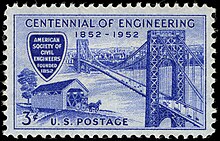
U.S. stamp commemorating the 100th ceremony of the ASCE in 1952
In 1999, the ASCE elected the top-ten "civil applied science achievements that had the greatest positive impact on life in the 20th century" in "wide categories". Monuments of the Millennium were a "combination of technical engineering accomplishment, backbone and inspiration, and a dramatic influence on the development of [their] communities".[15] The achievements and monuments that best exemplified them included:
- Airport design and evolution – the Kansai International Airport in Osaka, Japan
- Dams – the Hoover Dam on the Colorado River in the Us
- Interstate Highway System – "the system overall"[15]
- Long-span bridges – like the Gilt Gate Bridge in San Francisco, California
- Rail transportation – as exemplified by the Eurotunnel rail organisation connecting the Uk and France
- Sanitary landfills and solid waste disposal – "sanitary waste disposal advances overall"[15]
- Skyscrapers – the Empire State Building in Midtown Manhattan, New York City
- Wastewater handling – the Chicago wastewater organisation
- Water supply and distribution – the California State Water Projection
- Water transportation – the Panama Culvert
Overview [edit]
ASCE's mission is to deliver essential value to "its members, their careers, our partners, and the public" also as enable "the advancement of technology, encourage and provide the tools for lifelong learning, promote professionalism and the profession."[sixteen] [17] The society likewise seeks to "develop and support civil engineer leaders, and advocate infrastructure and environmental stewardship."[16] The society as an exempt organization in the United States (Section 501(c)(3)) was required to reported its plan service accomplishments and related expenses and revenues.[16]
Publications [edit]
ASCE stated that dissemination of technical and professional person information to the civil applied science profession was a major goal of the society.[16] This is accomplished through a variety of publications and information products, including 35 technical and professional person journals amongst them the ASCE Journal of Structural Engineering science, the Journal of Environmental Engineering, the Journal of Hydraulic Engineering, Periodical of Hydrologic Engineering, the Periodical of Transportation Engineering, Part A: Systems, Journal of H2o Resource Planning and Management, Civil Technology, the society's monthly magazine, an online bibliographic database, conference proceedings, standards, manuals of exercise and technical reports.[16] The ASCE Library contains 470+ E-books and standards, some with chapter-level access and no restrictive DRM, and 600+ online proceedings.
Conferences, meetings, and didactics [edit]
Each yr, more 55,000 engineers earn standing education units (CEUs) and/or professional development hours (PDHs) by participating in ASCE's continuing education programs. ASCE hosts more fifteen annual and specialty conferences, over 200 continuing education seminars and more than 300 live web seminars.[16] Meetings include "...committees, task forces, focus groups, workshops and seminars designed to join ceremonious engineering experts either from specific fields or those with a broad range of experience and skills. These meetings deal with specific topics and issues facing civil engineers such as America'due south failing infrastructure, sustainability, earthquakes, and bridge collapses."[xvi]
Engineering programs [edit]
The engineering programs division directly advances the scientific discipline of engineering by delivering technical content for ASCE's publications, conferences and continuing instruction programs. It consists of eight discipline specific institutes, 4 technical divisions and half-dozen technical councils. The work is accomplished by over 600 technical committees with editorial responsibleness for 28 of ASCE'due south 33 journals. On an annual basis, the division conducts more than twelve congresses and specialty conferences.[16] As a founding society of ANSI and accredited standards development organization, ASCE committees use an established and audited process to produce consensus standards under a programme supervised by the gild's Codes and Standards Committee.[eighteen]
Civil Applied science Certification Inc. (CEC), affiliated with ASCE, has been established to support specialty certification academies for ceremonious engineering specialties and is accredited by the Council of Applied science and Scientific Specialty Boards (CESB). CEC also handles safety certification for land, municipal, and federal buildings, formerly the province of the now-defunct Building Security Council. The Committee on Critical Infrastructure (CCI) provides vision and guidance on ASCE activities related to critical infrastructure resilience, including planning, design, structure, O&1000, and effect mitigation, response and recovery.
Certification is the recognition of attaining advanced knowledge and skills in a specialty area of civil engineering. ASCE offers certifications for engineers who demonstrate advanced knowledge and skills in their area of engineering.
- American Academy of Water Resources Engineers (AAWRE)
- University of Geo-Professionals (AGP)
- University of Coastal, Ocean, Port & Navigation Engineers (ACOPNE)
Institutes [edit]
ASCE too has nine full-service institutes created to serve working professionals working within specialized fields of civil technology:[19]
- Architectural Engineering Institute (AEI)
- Coasts, Oceans, Ports and Rivers Institute (COPRI)
- Construction Institute (CI)
- Engineering Mechanics Institute (EMI)
- Environmental and H2o Resources Institute (EWRI)
- Geo-Constitute (Chiliad-I)
- Transportation and Development Institute (T&DI)
- Structural Applied science Institute (SEI)
- Utility Engineering & Surveying Establish (UESI)
Advocacy [edit]
To advance its policy mission, ASCE "...identifies legislation to ameliorate the nation'south infrastructure, and accelerate the profession of engineering specifically, ASCE lobbied on legislation at the Federal, Land and local levels.[16] In 2015, ASCE's Lobbying at the Federal level was focused primarily upon:[16]
- Reauthorization of the federal surface transportation programs such as Moving Ahead for Progress in the 21st Century Act (MAP-21)
- Reauthorization of the brownfields revitalization and environmental restoration act.
- Reauthorization of the national dam rubber program and creation of a national levee safety plan due to National Levee Safety Deed Of 2007, WRDA Championship Nine, Section 9000.[20]
- Reauthorization of the Clean Water State Revolving Fund program
- Reauthorization of the drinking water land revolving fund program
- Water resources evolution act
- funding for stem education programs
- Reauthorization of the 1977 national earthquake hazards reduction program
- Reauthorization of the national windstorm affect reduction act
- Rubber building code incentive act
- Appropriations for federal programs relating to civil engineering science, including surface transportation, aviation, water resource, surround, education, homeland security, and research and development.
Lobbying at the state and local level focused primarily upon licensure of ceremonious engineers, procurement of engineering services, continuing education, and the financing of infrastructure improvements equally well equally lobbying at the state level to heighten the minimum requirements for licensure as a professional person engineer equally part of ASCE'south Raise the Bar (RTB) and Civil Technology Torso of Knowledge (CEBoK) initiatives.[xvi]
For 2018, ASCE identified Federal advocacy priorities as follows:[21]
- Ceremonious applied science education (college education)
- Make clean water, drinking water and wastewater issues
- Natural hazards mitigation & infrastructure security
- Qualifications-Based Selection for applied science services
- Enquiry and Development Funding
- Scientific discipline, technology, engineering science and math(STEM) didactics & back up (Thou-12)
- Sustainability, implicitly sustainable engineering
- Transportation infrastructure
The State advocacy priorities in 2022 are equally follows:[21]
- Licensing
- Natural Hazards Impact Mitigation
- Science, Engineering, Engineering and Math (Stalk) education & support (K-12)
- State support for civil engineering higher instruction
- Sustainability, implicitly sustainable engineering
- Tort reform & indemnification for pro bono services
- Transportation infrastructure financing
Strategic issues and initiatives [edit]
To promote the society's objectives and address cardinal problems facing the civil engineering profession, ASCE developed three strategic initiatives: Sustainable Infrastructure, the ASCE Grand Challenge, and Raise the Bar.[22]
Policy statements [edit]
ASCE developed policy statements on major technical, professional and educational issues of involvement to the civil engineering customs and the nation in the following areas:[23]
- Littoral zones, off shore and waterways
- Dams, alluvion control and levees
- Disaster mitigation and response
- Diverseness
- Educational activity, inclusive of statements on history and heritage of civil technology, STEM and academic prerequisites for licensure and professional practice laying out ASCE's Raise the Bar and Civil Technology Torso of Knowledge initiatives.[24]
- Free energy
- Engineering practice, inclusive of statements on civil technology project team, applied science surveying, Aesthetics, Professional Ethics and Conflict of Interest, Combating Abuse
- Environmental problems, inclusive of statements on acrid rain, concrete and economic impacts of climate change, pollution management, wetlands regulatory policy, back up for the Endangered Species, harmful algal blooms, greenhouse gases and electronic waste recycling.
- Government
- Hazardous and solid waste
- Infrastructure, inclusive of statements on
- Sustainable growth and evolution that integrates "... appropriate urban scale and course, diversity of land use and good technology blueprint to attain a balance between the interests of the individual, the community and the natural and built environments."[25] [26]
- Infrastructure investment with an effort to target the costs of installed infrastructure. ASCE argues that policy makers should seek to maximize the charge per unit of economic return on infrastructure investment. ASCE advocates for these decision-makers to follow established project and plan direction principles funded from a wide range of options and types of infrastructure debt such as defended user-fees, bonds, Public–private partnership, private investment, infrastructure banks such as the proposed National Infrastructure Reinvestment Bank, state and federal loan funds such equally the Highway Trust Fund or State Revolving Funds.[27] This effort had 3 sub-initiatives:
- Leadership in Infrastructure Renewal, ASCE makes the statement that the United States needs a "compelling and overarching vision" for infrastructure investment.[27] This statement on infrastructure policy and related reports[28] laid the conceptual framework for the ASCE Report Card for America's Infrastructure, related "Failure to Human action" reports[29] and State and Regional Infrastructure Written report Cards[30] and guiding principle recommendations for planning and executing critical infrastructure in the United states of america.
- Sustainability, Resiliency and Innovation, ASCE advocates that life-cycle price analysis should be a function of every new or renewed infrastructure project with funding allocated to develop new and improved techniques in delivering projects, construction engineering and building materials for meeting social club'southward infrastructure needs.[27] This argument on infrastructure policy and related reports[28] laid the conceptual framework for the ASCE Chiliad Challenge and related report on the recommended use of life-cycle price analysis in transportation planning.[28]
- Plans to Sustain and Enhance Infrastructure, ASCE makes the argument that infrastructure investment should be prioritized by plan managers and executed past projection managers; co-ordinate to well-conceived management plans that are consistent with the "...national vision and focus on system wide metrics."[27]
- Regulatory procedure for infrastructure development, ASCE advocates for strategies that expedite regulatory processes and related decision-making for disquisitional infrastructure projects to "proceed in a timely manner". Its recommendations in this area was for programs to require concurrent reviews by project stakeholders managing design codes (such as UBC and NEC)and other permitting such as wetlands dredge and make full for infrastructure projects. ASCE also recommended the creation of a "single administrative processing/permitting bureau" for approving plans for constructing disquisitional infrastructure likewise as time-limits on permitting bureau decision-making for approving infrastructure project plans.[31]
- International
- Legal reform
- Licensure
- Procurement/contract issues
- Public involvement
- Quality/standards
- Research
- Space
- Tax issues
- Transportation issues
- Wastewater
- Water resources management
Awards and designations [edit]

ASCE honors civil engineers through many Gild Awards including the Norman medal (1874), Wellington prize (1921), Huber Ceremonious Engineering Research Prize, the Outstanding Projects and Leaders (OPAL) awards in the categories of construction, pattern, education, authorities and management,[32] the Outstanding Civil Engineering Achievement (OCEA) for projects, the Henry Fifty. Michel Award for Industry Advancement of Enquiry and the Charles Pankow Award for innovation, 12 scholarships and fellowships for student members. Created in 1968 by ASCE's Sanitary Engineering Sectionalization, the Wesley W. Horner award is named after former ASCE President Wesley W. Horner, and given to a recently peer reviewed published paper in the fields of hydrology, urban drainage, or sewerage. Special consideration is given to individual practice engineering work that is recognized as a valuable contribution to the field of ecology engineering.[33] The Lifetime Achievement Honour has been presented annually since 1999 and recognizes v unlike private leaders. 1 award is present in each category of design, structure, government, pedagogy, and management.[34]
Walter L. Huber Civil Engineering science Research Prize [edit]
In July 1946, the Lath of Direction authorized annual awards on recommendation by the guild's Committee on Research to stimulate enquiry in civil engineering. In October 1964, Mrs. Alberta Reed Huber endowed these prizes in honor of her husband, Walter Fifty. Huber, past president, ASCE.[35] The Huber Prize is considered the highest level mid-career research prize in ceremonious engineering and is awarded for outstanding achievements and contributions in research with respect to all disciplines of civil applied science.
LTPP International Data Assay Competition Award [edit]
The LTPP International Information Analysis Contest is an annual information analysis competition held by the ASCE in collaboration with the Federal Highway Assistants (FHWA). The participants are supposed to employ the LTPP data.[36]
ASCE Foundation [edit]
The ASCE Foundation is a charitable foundation established in 1994 to support and promote ceremonious applied science programs that "... enhance quality of life, promote the profession, advance technical practices, and set up ceremonious engineers for tomorrow." It is incorporated separately from the ASCE, although it has a shut human relationship to information technology and all the foundation's personnel are employees of ASCE.[sixteen] The foundation board of directors has 7 persons and its bylaws require that iv of the seven directors must be ASCE officers also and the ASCE executive director and principal fiscal officeholder must also exist ASCE employees.[16] The foundation's back up is most often to ASCE's charitable, educational and scientific programs.[16] The foundation's largest program is supporting three strategic areas; lifelong learning and leadership, advocacy for infrastructure investment and the part of ceremonious engineers in sustainable practices.[16] In 2014, this foundation's back up in these areas was near U.s.a.$4 one thousand thousand.[sixteen]
Criticisms and historical controversies [edit]
Controversies in New Orleans levee investigations [edit]
Printing release of expert review panel 2007 [edit]
ASCE provides peer reviews at the request of public agencies and projects as a "ways to meliorate the management and quality of [public agency] services and thus better protect the public health and safety with which they are entrusted".[37] [38] After the 2005 levee failures in Greater New Orleans, the commander of the U.S. Army Corps of Engineers (Lt Gen Carl Strock P.Due east., Grand.ASCE) requested that ASCE create an expert review panel to peer review the corps-sponsored Interagency Functioning Evaluation Task Forcefulness, the body commissioned by the corps to assess the functioning of the hurricane protection system in metro New Orleans. Lawrence Roth, deputy executive director of the ASCE led the ERP development, served equally the console'due south principal of staff and facilitated its interaction with IPET.[39] The skillful panel's part was to provide an independent technical review of the IPET's activities and findings, equally stated at a National Research Council coming together in New Orleans: "an independent review panel ensure[due south] that the outcome is a robust, credible and defensible performance evaluation".[twoscore] On February 12, 2007, Lt. Gen Strock gave all expert review panel members an Outstanding Noncombatant Service Medals.[39]
On June 1, 2007, the ASCE issued its expert review panel written report,[41] and an accompanying printing release.[42] The press release was considered controversial because information technology independent data not nowadays in the report, conflicting with the written report, and minimized the Army Corps' involvement in the catastrophe: "Fifty-fifty without breaching, Hurricane Katrina's rainfall and surge overtopping would have acquired extensive and severe flooding—and the worst loss of life and property loss always experienced in New Orleans." The report stated that had levees and pump stations not failed, "far less property loss would have occurred and nearly 2-thirds of deaths could take been avoided."[41] : 39 The ASCE administration was criticized past the Times-Fiddling for an attempt to minimize and understate the office of the Army Corps in the flooding.[43]
Ideals complaint [edit]
In Oct 2007, Raymond Seed, a University of California-Berkeley ceremonious engineering professor and ASCE member, submitted a 42-folio ethics complaint to the ASCE alleging that the corps of engineers with ASCE'due south help sought to minimize the corps' mistakes in the flooding, intimidate anyone who tried to intervene, and delay the terminal results until the public'due south attention had turned elsewhere.[44] The corps acknowledged receiving a copy of the letter and refused to comment until the ASCE's Commission on Professional Acquit (CPC) had commented on the complaint.[45] It took over a year for the ASCE to denote the results of the CPC.[46] The ASCE self-study panel did not file charges of ethical misconduct and blamed errors on "staff" and not review panel members having created the June printing release."[47]
Review panels to examine declared ethics breaches [edit]
On November fourteen, 2007, ASCE announced that U.Southward. Congressman Sherwood Boehlert, R‑N.Y. (ret), would pb an independent job forcefulness of exterior experts to review how ASCE participated in applied science studies of national significance.[48] ASCE President David Mongan said the review was to address criticism of ASCE´south role in profitable the Army Corps of Engineers-sponsored investigation of Katrina failures. Mongan bodacious citizens of metro New Orleans in a alphabetic character to the Times Little, that ASCE took "this thing very seriously and that appropriate actions are being taken".[49]
The console recommended in results released on September 12, 2008, that ASCE should immediately take steps to remove the potential for conflict of interest in its participation in post-disaster engineering science studies.[50] The most of import recommendations were that peer review funds over $i million should come from a separate source, like the National Institute of Standards and Technology (NIST), that ASCE should facilitate but not command the cess teams, and that information to the public and press should exist disseminated not under the extremely tight controls that Ray Seed and his team experienced. It ended that ASCE should draw up an ethics policy to eliminate questions of possible conflicts of interest.[fifty]
On April six, 2009, an internal probe with the ASCE issued a study that ordered a retraction of the ASCE's June 1, 2007, press release.[47] The panel determined that the press release had "inadvertently conveyed a misleading impression regarding the office of engineering failures in the devastation of New Orleans", that it incorrectly said that surge levels along Mississippi'south coastline were higher than water levels acquired by a tsunami in the Indian Ocean in 2004, and that it had incorrectly repeated estimates of deaths and property impairment in New Orleans that might have occurred if levees and floodwalls had non been breached.
Grassroots grouping spoof of ASCE - USACE relationship [edit]
On November five, 2007, New Orleans-based grassroots grouping Levees.org led past Sandy Rosenthal criticized the ASCE's shut relationship with the United states Ground forces Corps of Engineers in a spoof online public service annunciation.[51] On November 12, 2007, the ASCE asked Levees.org to remove the video from the internet, threatening the organization with legal action if information technology did not comply.[52] On Nov 13, the Times-Piddling posted the video on its website.[53] Flanked by lawyers with Adams and Reese in the presence of extensive media coverage, the group ignored the threat and posted the video to YouTube citing Louisiana's Anti-SLAPP statute, a "strategic lawsuit against public participation", which allows courts to weed out lawsuits designed to chill public participation on matters of public significance.[54] In a response for annotate, ASCE President Mongan replied, "Since the video has already been widely reposted by other organizations, moving forward, we experience our time and expertise are best utilized working to assistance protect the residents of New Orleans from future storms and flooding."[54]
USACE grant money for disinformation, 2008 [edit]
In March 2008, Levees.org announced that records obtained under the Freedom of Information Act revealed that as early October 2005, the Army Corps of Engineers had directed and afterwards paid the ASCE more than $1.1 million for its peer review (Grant Number: W912HZ-06-1-0001). The grant as well paid for a series of misleading ASCE presentations attempting to shift blame abroad from the corps and onto local levee officials.[55] Members of the ASCE are forbidden from making faux or exaggerated statements and besides from making statements for an interested party unless this is disclosed. Levees.org claimed the records showed how the external peer review would be done in four phases: Phase ane was research and analysis on the operation of the levees, floodwalls and other of import structures. Phase ii was provision of information on the current system to prevent futurity flooding. Stage three was provision of information to evaluate culling approaches to flood protection. Phase four was transfer information and knowledge gained to a broader audience within Corps and its consultancy community to communicate lessons learned. The group claimed that these records[56] were proof that ASCE's routine powerpoint presentation from 2007 and 2008 were a public relations campaign to repair the corps' reputation.[57] ASCE officials responded that ASCE paid for the powerpoint presentations itself and had not used USACE grant coin for that purpose.
Meet likewise [edit]
- ASCE Library
References [edit]
- ^ a b c
 This article incorporates text from this source, which is in the public domain . "IRS Form 990 for American Club Of Ceremonious Engineers Grouping (510202274) for 09/2008 from CitizenAudit.org" (PDF). Denizen Audit . Retrieved Nov 7, 2017.
 - ^ a b "Annual Report 2019" (PDF). American Society of Civil Engineers. Retrieved August 25, 2020.
- ^ "ASCE Founders' Plaque". Metropolitan Section, American Club of Ceremonious Engineers. Retrieved November 12, 2016.
- ^ Perspectives in Civil Engineering: Commemorating the 150th Ceremony of the American Society of Civil Engineers Jeffrey South. Russell; ASCE Publications, January 1, 2003; 392 pages, folio 129 "They used the constitution of the Boston Society of Ceremonious Engineers, founded four years before, equally a framework."
- ^ a b Goldman, Joanne Abel. Building New York's Sewers: Developing mechanisms of urban management. Purdue Academy Press, 1997, page 112. Accessed at Google books
- ^ a b c d due east f m h i j g 50 m Calhoun, Daniel Hovey. The American ceremonious engineer: Origins and disharmonize. Engineering science Printing, Massachusetts Institute of Technology, 1960.
- ^ Weingardt, Richard G. (2005). Engineering science Legends: Great American Civil Engineers: 32 Profiles Of Inspiration And Accomplishment. Reston: ASCE Publications. pp. 4–9. ISBN0-7844-0801-seven . Retrieved October 7, 2011.
- ^ a b c d eastward f g h i j k l m This article incorporates text from this source, which is in the public domain . Hunt, C. Warren. (1897). Historical sketch of the American Society of Civil Engineers. New York: [Printed past guild of the Board of Management]. Accessed at HathiTrust
- ^ a b c Schlesinger, A. (1944). Biography of a Nation of Joiners. The American Historical Review, l(one), 1-25. doi:ten.2307/1843565 Accessed on November 9, 2017, at JSTOR=1843556.
- ^ a b c d "Order House of the American Society of Ceremonious Engineers" (PDF). New York City Landmarks Preservation Commission. December 16, 2008. Retrieved November 16, 2020.
- ^ This article incorporates text from this source, which is in the public domain . American Order of Civil Engineers., American Order of Civil Engineers., (1877). Transactions – American Order of Civil Engineers. New York. Accessed at Google Books on November 10, 2017.
- ^ Danuta Bois. "Nora Stanton Blatch Barney profile". Distinguished Women of Past and Present . Retrieved July 4, 2011.
- ^ "Nora Stanton Blatch contour". IEEE Global History Network . Retrieved July four, 2011.
- ^ "ASCE Recognizes Stanton Blatch Barney; Pioneering Civil Engineer, Suffragist". ASCE News . Retrieved Feb ten, 2016.
- ^ a b c "Top 10 Achievements & Millennium Monuments" (PDF). People and Projects > Projects. American Lodge of Civil Engineers. Retrieved September nineteen, 2012.
- ^ a b c d e f g h i j k l m due north o p This article incorporates text from this source, which is in the public domain . "American Society of Civil Engineers Foundation, Inc. - 52-1891243". GuideStar. Internal Revenue Service Form 990. Retrieved August 26, 2020.
- ^ This article incorporates text from this source, which is in the public domain . "Form 990 of ASCE Foundation for Financial Yr 2013" (PDF). ASCE Foundation. Internal Revenue Service. Retrieved May 21, 2019.
- ^ "ANSI Accredited Standards Developer (ASD) List (Large File)". American National Standards Institute (ANSI). Retrieved November 10, 2017.
- ^ "Institutes". ASCE.org . Retrieved March twenty, 2016.
- ^ "National Levee Safety Programme (National Levee Safety Deed of 2007 every bit Amended by WRRDA 2022 S3016)" (PDF). Us Club on Dams (USSD). United States Society on Dams (USSD). Retrieved November 10, 2017.
- ^ a b "ASCE'due south Public Policy Committee identified the following federal and state priorities for 2018". American Society of Civil Engineers (ASCE). American Gild of Ceremonious Engineers (ASCE). Retrieved Nov 11, 2017.
- ^ "OUR INITIATIVES". American Guild of Civil Engineers (ASCE). American Society of Civil Engineers (ASCE). Archived from the original on November twenty, 2017. Retrieved Nov xi, 2017.
- ^ "PUBLIC POLICY STATEMENTS". American Social club of Civil Engineers. American Society of Civil Engineers. Retrieved November eleven, 2017.
- ^ "ASCE Policy statement 465 – Academic prerequisites for licensure and professional person exercise". American Society of Civil Engineers (ASCE). American Order of Civil Engineers (ASCE). Retrieved November 11, 2017.
- ^ "Policy argument 131 – Growth and development". American Society of Civil Engineers (ASCE). American Guild of Ceremonious Engineers (ASCE). Retrieved November 11, 2017.
- ^ Lélé, Sharachchandra M. "Sustainable evolution: a critical review." Earth evolution 19.6 (1991): 607-621. Accessed at [1]
- ^ a b c d "ASCE Policy statement 299 – Infrastructure investment". American Society of Ceremonious Engineers. American Society of Civil Engineers. Retrieved November 11, 2017.
- ^ a b c "ASCE infrastructure policy reports". American Gild of Civil Engineers (ASCE). American Order of Civil Engineers (ASCE). Retrieved November 11, 2017.
- ^ "Failure to Deed study serial". American Society of Civil Engineers (ASCE). American Guild of Ceremonious Engineers (ASCE). Retrieved November xi, 2017.
- ^ "State and Regional Infrastructure Report Cards by ASCE local sections programme". American Society of Civil Engineers (ASCE). American Society of Civil Engineers (ASCE). Retrieved November 11, 2017.
- ^ "ASCE Policy statement 427 – Regulatory process for infrastructure evolution". American Society of Civil Engineers (ASCE). American Gild of Civil Engineers (ASCE). Retrieved Nov 11, 2017.
- ^ American Society of Civil Engineers. "ASCE Honors and Awards – Outstanding Civil Engineering Achievement". Archived from the original on August 29, 2008. Retrieved Baronial 31, 2008.
- ^ Wesley Due west. Horner Award Archived September 27, 2007, at the Wayback Machine ASCE. Accessed October 10, 2007.
- ^ American Lodge of Ceremonious Engineers. "ASCE Honors and Awards – Lifetime Achievement Honour". Archived from the original on August 29, 2008. Retrieved August 31, 2008.
- ^ "Walter L. Huber Civil Engineering science Research Prizes". ASCE. Retrieved April 17, 2017.
- ^ Nehme, Jean (September 29, 2016). "LTPP International Data Analysis Contest". Federal Highway Administration. Retrieved October 22, 2017.
- ^ Peer Review for Public Agencies American Society of Civil Engineers. Not dated, Retrieved November 17, 2007.
- ^ ASCE Policy Argument on Peer Review American Society of Civil Engineers, March 17, 2016, retrieved November 13, 2015.
- ^ a b (March 2007) Members Honored with Outstanding Ceremonious Services Medal Archived March 4, 2016, at the Wayback Auto American Society of Civil Engineers. Retrieved Nov 13, 2015.
- ^ Roth, Lawrence "Larry", on behalf of ASCE External Review Panel. (March 20, 2007) Meeting 2, New Orleans Regional Hurricane Protection Projects, Meeting 2, New Orleans Regional Hurricane Protection Projects. New Orleans, LA. Retrieved November xv, 2015.
- ^ a b Charles F. Anderson, Jurjen A. Battjes; et al. (2007). "The New Orleans Hurricane Protection System: What Went Wrong and Why" (PDF). American Order of Ceremonious Engineers. p. lxxx. Retrieved November 15, 2015.
- ^ Joan Buhrman (2007). "Motion Across Sound-bites and "Armchair" Theories to Make the Nation Safer From Disaster, Engineers Say" (PDF). American Order of Civil Engineers. Retrieved November 15, 2015.
- ^ (June 19, 2007) EDITORIAL: Sound bites and spin jobs The Times-Picayune. Retrieved November 17, 2015.
- ^ Raymond B. Seed (2007). "New Orleans, Hurricane Katrina, and the Soul of the Profession" (PDF). New Orleans Times Picayue. Retrieved January 27, 2017.
- ^ Charpentier, Colley (Nov 19, 2007). "Critic: Corps tried to thwart inquirty". Times Picayune. Archived from the original on July 25, 2011. Retrieved November xvi, 2015.
- ^ "Levee group slams ASCE investigation" (PDF). NOLA.com. August 6, 2008. Retrieved January 27, 2017.
- ^ a b Schleifstein, Mark (April 6, 2009). "American Society of Civil Engineers finds no upstanding violations in its ain Katrina levee review". Times Footling. Retrieved November 16, 2015.
- ^ Task force volition review engineers' studies The Times Picayune, December viii, 2007
- ^ ASCE is investigating The Times Fiddling, December 2, 2007
- ^ a b Sherwood 50. Boehlert, Joseph Bordogna (September 12, 2008). "Written report on Engineering science Reviews: Recommendations to the American Guild of Civil Engineers" (PDF). Archived from the original (PDF) on March 4, 2016. Retrieved Jan 27, 2017.
- ^ Levees.Org (Nov 5, 2007). New Orleans Levee Spin 101 (Youtube Video). New Orleans, LA: Levees.org.
- ^ Baquet, Terry (November thirteen, 2007). "Engineer group not amused by online spoof of levee review". Times Picayune. Retrieved November 16, 2015.
- ^ Shea, Dan (November 14, 2007). "Controversial Levees.org video". Times Picayune. Retrieved November 16, 2015.
- ^ a b Betz, Jonathan (Dec 4, 2007). "Corps/Levees.org". WWL. Archived from the original on November 17, 2015. Retrieved Nov 16, 2015.
- ^ Sandy Rosenthal (August 22, 2011). Elite Applied science Group Does PR Evidence to Protect Corps of Engineers' Reputation (Youtube Video). New Orleans, LA: Levees.org.
- ^ U.S. Ground forces Engineer Research and Development Center (2006). "Research and Analysis of the Operation of Hurricane and Flood Protection Projects in Southeast Louisiana" (PDF). Department of the Army. Retrieved November xvi, 2015.
- ^ "Katrina Study Findings Presentations". American Club of Civil Engineers. September 2006. Retrieved November 16, 2015.
External links [edit]
- Official website

- Works by American Society of Ceremonious Engineers at Projection Gutenberg
- Works by or about American Society of Civil Engineers at Internet Archive
- "Centennial of Technology" – A 3¢ commemorative US postage stamp postage issued in 1952
alvarezcreeidell1956.blogspot.com
Source: https://en.wikipedia.org/wiki/American_Society_of_Civil_Engineers
0 Response to "How Does the Alternative Dispute Resolution Method Peer Review Work?"
Post a Comment